
Is your air conditioner running for 18 hours a day just to keep your Marietta living room at 72 degrees? Most homeowners don’t realize that failing seals can hike cooling costs by 25% or more during a typical Georgia summer. If you’ve noticed persistent condensation between glass panes or sashes that are painted shut, you’re likely seeing the obvious signs you need new windows. You deserve a home that stays comfortable without draining your bank account every month. We understand the frustration of dealing with windows that simply won’t cooperate when you want a breeze.
At A1 Window Services, we prioritize your home’s integrity over a quick sale. We want to help you determine if a professional replacement is necessary or if a targeted repair can save you money. This 2026 guide provides a straightforward framework to evaluate your home’s performance. We’ll examine everything from foggy thermal panes to broken hardware that compromises your safety. By the end of this checklist, you’ll know exactly how to lower your energy bills and keep the Georgia heat outside where it belongs. Let’s look at the seven red flags that mean it’s time to upgrade your home’s efficiency and security.
Key Takeaways
- Identify the “Big Three” visual red flags—rot, water stains, and warping—that signal your window frames are no longer structurally sound.
- Master a simple “smoke test” to find hidden air leaks and understand why glass that feels hot to the touch is failing the Georgia heat test.
- Learn to distinguish between temporary surface moisture and permanent seal failure to understand the common signs you need new windows.
- Save time and money by knowing exactly when a quick repair like weatherstripping will suffice versus when wood rot demands a professional replacement.
- Discover how modern window upgrades transform the look of classic Marietta home styles while significantly boosting your property’s 2026 resale value.
Visible Damage and Operational Failures: Is Your Window Structurally Sound?
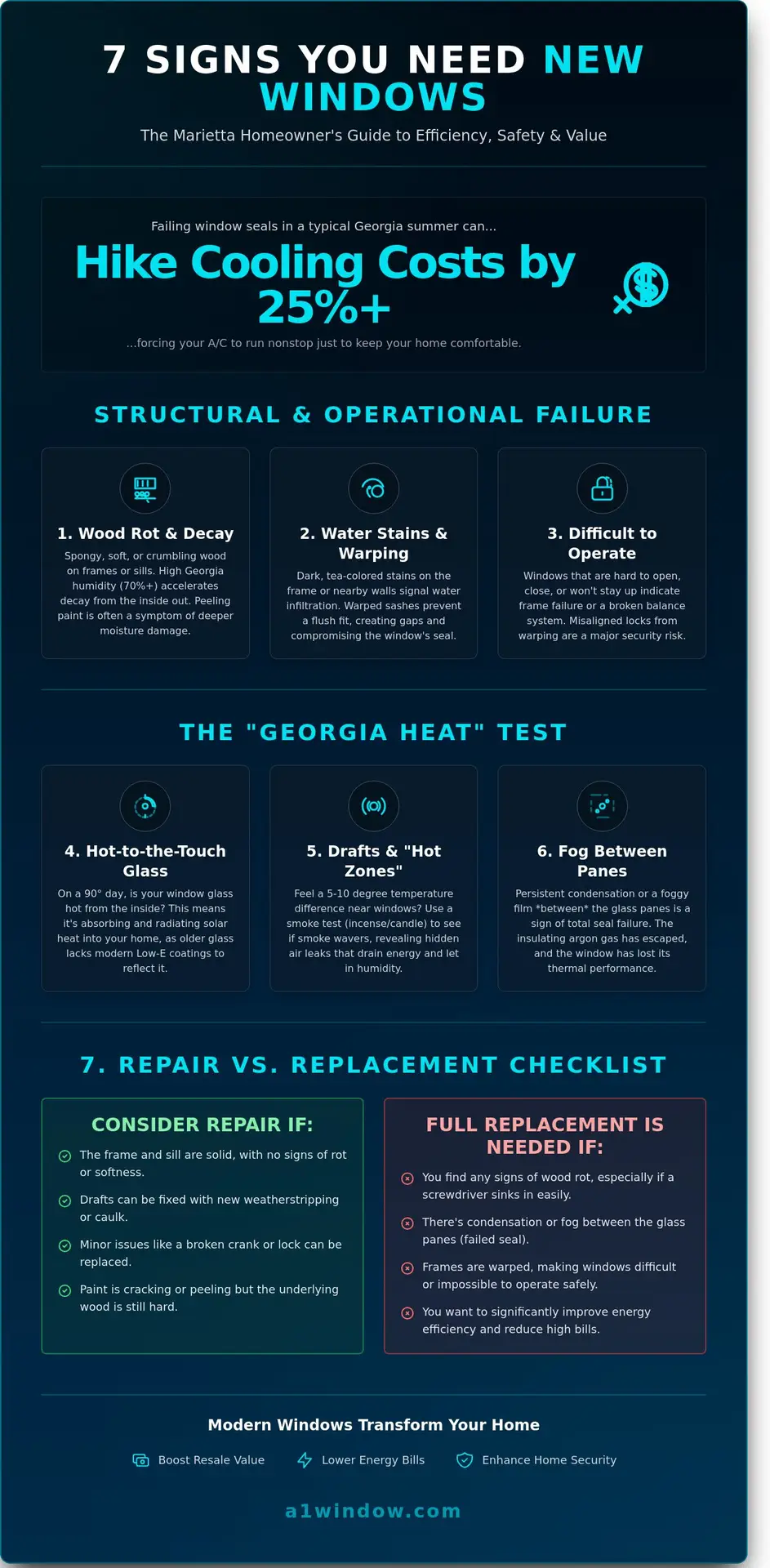
Marietta homeowners face unique challenges due to the local climate. With an average annual rainfall of 52 inches in Cobb County, your windows endure constant moisture cycles. Identifying the signs you need new windows starts with a close inspection of the “Big Three” visual red flags: rot, water stains, and warping. These symptoms indicate that your window sash or frame can no longer protect your home interior from the North Georgia elements.
Structural integrity is the foundation of home safety. You can test your frames using the screwdriver probe method. Take a flathead screwdriver and gently press the tip into the wooden sill or casing. If the tool sinks more than 1/8 of an inch into the wood with minimal pressure, the material is compromised. At this stage, the wood has lost its load-bearing capacity and cannot hold fasteners or hardware securely.
- Rot: Spongy wood that crumbles or feels soft to the touch.
- Water Stains: Dark, tea-colored discolorations on the frame or adjacent drywall.
- Warping: Visible curves in the sash that prevent the window from sitting flush in the frame.
Rotting Frames and Water Infiltration
North Georgia humidity levels often exceed 70% during summer months, which accelerates decay in older wood frames. Check for soft spots in the sill caused by persistent Georgia rain. If you notice peeling or bubbling paint, it is rarely just an aesthetic issue. These marks typically signal deep-seated moisture trapped behind the finish. Surface-level painting won’t fix structural rot. In fact, 90% of wood decay occurs from the inside out, meaning the damage is usually more extensive than what you see on the exterior.
Difficulty Opening, Closing, or Locking
The heavy red clay in Marietta is prone to expansion and contraction, leading to frequent foundation shifts. Even a shift of 1/4 inch can pull a window frame out of square. This misalignment makes windows difficult to operate. A stuck sash is more than an annoyance; it is a significant safety hazard during an emergency. If a window requires excessive force to open or won’t stay up on its own, the internal balance system or the frame itself has failed.
Security is another critical factor. When a frame warps, the locking mechanisms often fail to line up correctly. If you have to “jiggle” the lock or pull the sash with extra force to engage the bolt, your home’s security is at risk. These operational failures are clear signs you need new windows to restore both functionality and peace of mind. A1 Window Services prioritizes these repairs to ensure your home remains a safe environment for your family.
The “Georgia Heat” Test: Drafts, Hot Glass, and Sky-High Energy Bills
Marietta summers reach 90 degrees or higher for an average of 40 days per year. Your windows are the primary defense against this intense humidity and heat. If you walk by a window and feel a sudden wall of warmth, your home’s envelope is compromised. One of the most reliable signs you need new windows is glass that feels hot to the touch from the inside. Modern windows use Low-E coatings to reflect solar energy, but older glass absorbs it, radiating heat directly into your living room.
You can identify invisible air leaks with a simple smoke test. Close your windows tightly and turn off your HVAC system. Light an incense stick or a small candle and move it slowly around the edges of the window frame and the sash. If the smoke wavers or pulls toward the wood, you have a leak. These gaps allow Georgia’s humidity to seep in, forcing your air conditioner to work twice as hard to dehumidify your home. This struggle shows up every month on your GA Power bill during the peak cooling season.
Thermal expansion is another hidden enemy in Cobb County. The Atlanta sun causes window frames to expand and contract daily. This constant movement eventually kills window seals, allowing the insulating argon gas to leak out. Once the seal fails, the window loses its ability to block heat transfer. If you see moisture between the panes after a morning rain, the seal is gone and the unit is no longer performing its job.
Drafts and Temperature Fluctuations
Identify “dead zones” in your Marietta home where the temperature feels 5 to 10 degrees higher than the rest of the house. Drafts are more than just a comfort issue; they represent a constant energy drain that never stops. If your curtains move when the window is closed, you are paying to cool the outdoors. You can see how much this costs you by reading our guide: Do New Windows Save Energy? A Marietta Homeowner’s Guide.
The Hidden Cost of Single-Pane Windows
Single-pane glass is effectively obsolete for the North Georgia climate. These units offer almost zero insulation against the 95-degree July heat. When comparing efficiency, look at the U-Factor. Old single-pane windows often have a U-Factor of 1.0 or higher, while modern double-pane units sit at 0.30 or lower. In Marietta, the U-Factor measures how well a window prevents heat from moving into your home during a 95-degree July afternoon. Switching to double-pane glass can reduce your heat gain by up to 75% compared to clear, single-pane glass. Understanding the window u-factor for Georgia helps you choose the most efficient glass for our humid climate. These performance gaps are clear signs you need new windows to protect your home’s value.
Foggy Panes and Condensation: Understanding Seal Failure in Metro Atlanta
Marietta homeowners often spot fog between their window panes after a heavy Georgia rain or a humid July morning. This isn’t a cleaning issue. It’s a “blown seal.” When the perimeter seal of an Insulated Glass Unit (IGU) fails, the factory-sealed environment is compromised. This is one of the most definitive signs you need new windows because the damage is internal and irreversible.
In Metro Atlanta, the “Solar Pumping” effect accelerates this process. During a typical 95-degree summer day, the sun heats the air between your window panes to over 130 degrees Fahrenheit. This causes the air to expand and press against the seals. As the sun sets and temperatures drop, the glass cools and sucks in moisture-heavy air from the outside. Over several seasons, this constant expansion and contraction stresses the sealant until it develops microscopic cracks. Once the seal breaches, the heavy insulating Argon gas escapes, replaced by humid air that creates that tell-tale internal fog.
Failed seals do more than block your view. They significantly impact your home’s internal environment. A window with a compromised seal can increase your indoor humidity levels by 10% to 15%, forcing your HVAC system to work harder to maintain comfort. You’re no longer looking through an insulated barrier; you’re looking through two pieces of glass with a pocket of damp air between them.
Condensation Between the Glass
It’s vital to distinguish between surface moisture and internal fogging. If you can wipe the dew off with a towel, your window is likely fine. If the moisture remains out of reach, the unit has failed. You cannot clean the inside of a double-pane unit without breaking the glass. A breached seal typically results in a 30% loss of the window’s original R-value. This thermal leak allows heat to transfer directly into your living room, regardless of how high you turn up the air conditioning.
The “White Powder” or Calcium Deposit Sign
If you ignore foggy glass for too long, you’ll eventually see a white, hazy residue or “river tracks” on the inner surfaces. This is one of the advanced signs you need new windows. This residue consists of calcium and magnesium deposits left behind as moisture evaporates. These minerals are often pulled from the desiccant—the material inside the window spacer designed to absorb small amounts of moisture.
- Permanent Etching: These deposits eventually etch the glass, causing permanent physical damage that no professional cleaning can fix.
- Curb Appeal: In the competitive Marietta real estate market, foggy windows suggest a lack of maintenance, often reducing perceived home value by thousands of dollars.
- Visibility: Long-term seal failure eventually turns transparent glass into a milky, opaque surface that blocks natural light.
A1 Window Services focuses on restoring clarity and efficiency. While some companies suggest temporary “defogging” holes, these don’t replace the lost Argon gas or fix the thermal bridge. For Marietta homes built before 2010, replacing the failed glass units or the entire window is the only way to restore the 2026 standard for energy efficiency.
The Marietta Homeowner’s Checklist: Repair vs. Full Replacement
Marietta homeowners often struggle to decide if a weekend DIY fix will suffice or if a professional crew is necessary. Choosing the wrong path leads to wasted money on temporary patches that don’t solve the underlying structural issues. You should evaluate the signs you need new windows by looking at the frame’s integrity first. If the core structure is compromised, a tube of caulk is just a cosmetic Band-Aid on a major wound.
When Repair is a Viable Option
Minor issues don’t always require a full overhaul. If your window frames are solid and rot-free, simple repairs can extend their life for another season. You can fix broken sash locks, replace worn-out crank handles on casement windows, or swap out single-pane glass if it’s cracked. Replacing brittle weatherstripping costs about $50 per unit and can stop minor drafts. These aesthetic and mechanical fixes work well when the thermal seal of the window remains intact.
When Replacement is the Only Solution
Structural failure requires a permanent fix. If you see condensation trapped between double-pane glass, the factory seal has failed and the insulating gas is gone. Modern efficiency standards in 2026 demand better performance than a failed unit can provide. You can compare your current situation against the 2026 Window Replacement Cost in Marietta, GA to see how an upgrade fits your budget. Replacement is the only way to fix warped frames or widespread seal failure.
Wood rot represents the “Point of No Return” for any window. Take a screwdriver and press it into the exterior windowsill or the bottom of the sash. If the tool sinks more than 1/4 inch into the wood, the fibers have collapsed. Soft wood cannot hold hardware or provide a weather-tight seal. At this stage, attempting a repair is a poor investment because the rot will continue to spread to your home’s wall studs and insulation.
A cost-benefit analysis usually favors replacement when your energy bills climb 15% to 20% during a Marietta summer. While a temporary repair might cost $200, it does nothing to lower your monthly utility costs. A full replacement provides a fresh thermal break and stops the air leaks that force your AC to run constantly. Modern vinyl and composite frames offer lifetime performance that old wood units simply cannot match.
A1 Window focuses on full replacement because it’s the only way to guarantee the A1 standard of quality. We don’t believe in partial fixes that leave you searching for signs you need new windows again in eighteen months. By replacing the entire unit, we ensure the flashing, insulation, and frame are perfectly integrated to protect your home from Georgia’s humidity and unpredictable storms.
Ready to stop the drafts and start saving? Schedule your professional window assessment with our local Marietta team today.
Upgrading Your Cobb County Curb Appeal: Beyond Just Function
New windows do more than just lower your utility bills. They completely refresh the visual identity of your home. If you own a classic Marietta split-level or a traditional colonial in the East Cobb area, outdated frames can make the entire property look weathered. Peeling wood or warped vinyl are obvious signs you need new windows, but the aesthetic upgrade provides a fresh start. In the 2026 real estate market, first impressions are everything. Replacing old units with modern, high-performance frames can increase your home’s resale value by an estimated 68% to 73% of the project cost according to recent regional cost versus value reports.
There’s also a significant psychological benefit to “clarity.” Modern glass technology stays cleaner for longer periods. New designs feature tilt-in sashes that allow you to clean the exterior glass from inside your home. You’ll no longer need to balance on a ladder to reach the second story of your Marietta colonial. This ease of maintenance ensures your home always looks its best for neighbors and potential buyers alike.
Matching Style to Marietta Architecture
Double Hung windows remain the gold standard for Cobb County homes because they respect the traditional lines of local architecture. They offer excellent ventilation and a timeless look that fits almost any neighborhood from Kennesaw to Smyrna. If your home overlooks the rolling hills of North Georgia, consider incorporating large Picture windows. These fixed units frame your outdoor views like a piece of art and maximize natural light. For more detailed advice on specific products, check out our guide on Choosing the Best Replacement Windows for Marietta Homes.
Noise Reduction: The Quiet Advantage
Marietta is a vibrant, growing city, but that growth brings extra noise. If you live near the I-75 corridor, the 120 Loop, or busy thoroughfares like Dallas Highway, your home should be a sanctuary from the roar of traffic. One of the most overlooked signs you need new windows is when you can clearly hear neighbors’ conversations or distant sirens while your windows are closed. Modern replacements act as a sound barrier that older single-pane or failing double-pane units simply can’t match.
Homeowners should look at the Sound Transmission Class (STC) ratings when selecting new glass. A higher STC rating means better soundproofing. Consider these facts about home acoustics:
- Standard older windows typically have an STC rating between 26 and 28.
- High-performance acoustic glass can achieve an STC rating of 34 or higher.
- An increase of 10 points in an STC rating can make the perceived noise level drop by nearly 50%.
A quiet interior is a major selling point in the Metro Atlanta market. It signals to buyers that the home is well-built and insulated from the outside world. At A1 Window Services, we prioritize this “quiet comfort” because we know it transforms how you experience your living space every single day.
Secure Your Marietta Home Performance Today
Ignoring the signs you need new windows leads to higher utility costs and potential moisture damage. If you feel the 95 degree Georgia heat radiating through your glass or struggle with sashes that won’t budge, your home’s efficiency is compromised. Foggy panes are a clear signal of seal failure, which impacts both your comfort and your monthly energy bills. A1 Window has served Marietta and Metro Atlanta since 1993, providing expert guidance on full residential window replacement. We understand how the local climate affects your property’s exterior. Our team focuses on straightforward solutions that restore your home’s integrity without high-pressure sales tactics. We’ve spent 33 years helping neighbors in Cobb County improve their curb appeal and thermal protection. Professional replacement ensures your home stays cool during the humid summer and dry during the rainy season. Take the first step toward a more efficient, beautiful home with a team that values your time and budget. Get Your Free Marietta Window Inspection and Quote from A1 Window Today. You’ll enjoy a more comfortable living space immediately.
Frequently Asked Questions
How do I know if my windows are just drafty or if the seals have actually failed?
Drafty windows often just need new weatherstripping, but failed seals create permanent condensation inside the thermal pane. If you see fogging that you can’t wipe away, your seal has failed. A1 Window Services identifies these issues by checking for moisture between the double-pane glass. Failed seals mean your window lost its insulating gas, which can increase heat transfer by 25 percent compared to a sealed unit.
Is it worth replacing 20-year-old windows if they still open and close?
If your windows are 20 years old, they likely lack the Low-E coatings found in modern units. Even if they open, they probably have a U-factor above 0.50, whereas new Energy Star windows in Marietta hit 0.27 or lower. These aging units often represent the biggest signs you need new windows because they let in 40 percent more heat during Georgia summers than modern alternatives.
Can I replace just the glass instead of the whole window unit in Marietta?
You can replace just the glass in Marietta if your frames are still structurally sound. This process, known as a moisture-free glass replacement, costs about 50 percent less than a full frame installation. We focus on restoring the thermal pane while keeping your original sash. It’s an honest way to fix foggy glass without the high price of a total tear-out.
What is the average lifespan of residential windows in the Georgia climate?
Residential windows in the Georgia climate typically last 15 to 25 years. The high humidity and 90 degree summer days cause wood frames to rot and vinyl to expand or contract. By year 20, most seals have degraded. We’ve seen that windows on the south-facing side of Marietta homes often fail 5 years sooner due to intense UV exposure.
Do new windows really lower my GA Power bill significantly?
New windows can lower your GA Power bill by an average of 12 percent annually. According to Energy Star data for the Southern climate zone, upgrading from clear glass to high-performance panes saves a typical Marietta household about $150 per year. You’ll notice the biggest difference during July and August when your air conditioner runs 20 percent less frequently to maintain a 72 degree indoor temperature.
How can I tell if my window frames are rotting under the paint?
You can detect rot under paint by pressing a screwdriver into the wood at the corners of the window sash. If the tool sinks more than 1/4 inch into the wood, the frame is compromised. Paint often hides soft spots that allow water to seep into your walls. This structural decay is one of the clearest signs you need new windows to protect your home’s integrity.
Should I replace all my windows at once or can I do them room by room?
You can certainly replace windows room by room to manage your budget. Many Marietta homeowners start with the front of the house for curb appeal or focus on the master bedroom to stop drafts. While doing the whole house at once might save 10 percent on labor costs, a phased approach is a practical way to upgrade your home without a massive upfront investment.
What are the best energy-efficient windows for the Atlanta area heat?
The best windows for the Atlanta heat feature double-pane glass with a Low-E coating and Argon gas fills. Look for a Solar Heat Gain Coefficient (SHGC) of 0.25 or less. These windows block 75 percent of the sun’s infrared heat while letting in natural light. This setup keeps your living room significantly cooler during those 95 degree Georgia afternoons without overworking your HVAC system.