
Last July, a Marietta homeowner discovered their air conditioner was running 19 hours a day just to keep the living room at 74 degrees. It’s a frustrating reality for many in Metro Atlanta, where 31% of a home’s cooling energy typically escapes through inefficient glass and drafty sashes. You already know that your rising Georgia Power bill is tied to those aging double-hung windows, but you’re likely asking: do new windows save energy enough to justify the investment?
At A1 Window Services, we believe in providing clear answers rather than high-pressure sales pitches. This guide explores the honest truth about how replacement windows impact your monthly costs and home comfort in our humid Georgia climate. You’ll learn the difference between a $15,000 full replacement and a more affordable thermal pane repair. We’ll also break down specific performance ratings for 2026 to help you decide which path actually puts money back in your pocket.
Key Takeaways
- Understand how Georgia’s heat and humidity impact your home and why old windows often act like heaters during the summer months.
- Get an honest look at the math to answer the question: do new windows save energy in a way that provides a real return on investment?
- Learn to decode industry ratings like U-Factor and SHGC so you can choose the most efficient thermal panes for the Marietta climate.
- Identify the physical signs of window failure, including how to use the “Touch Test” to spot energy leaks before your next power bill arrives.
- Discover why professional installation and proper foam insulation are just as critical as the window glass itself for achieving maximum efficiency.
How Much Energy Do New Windows Actually Save in Marietta?
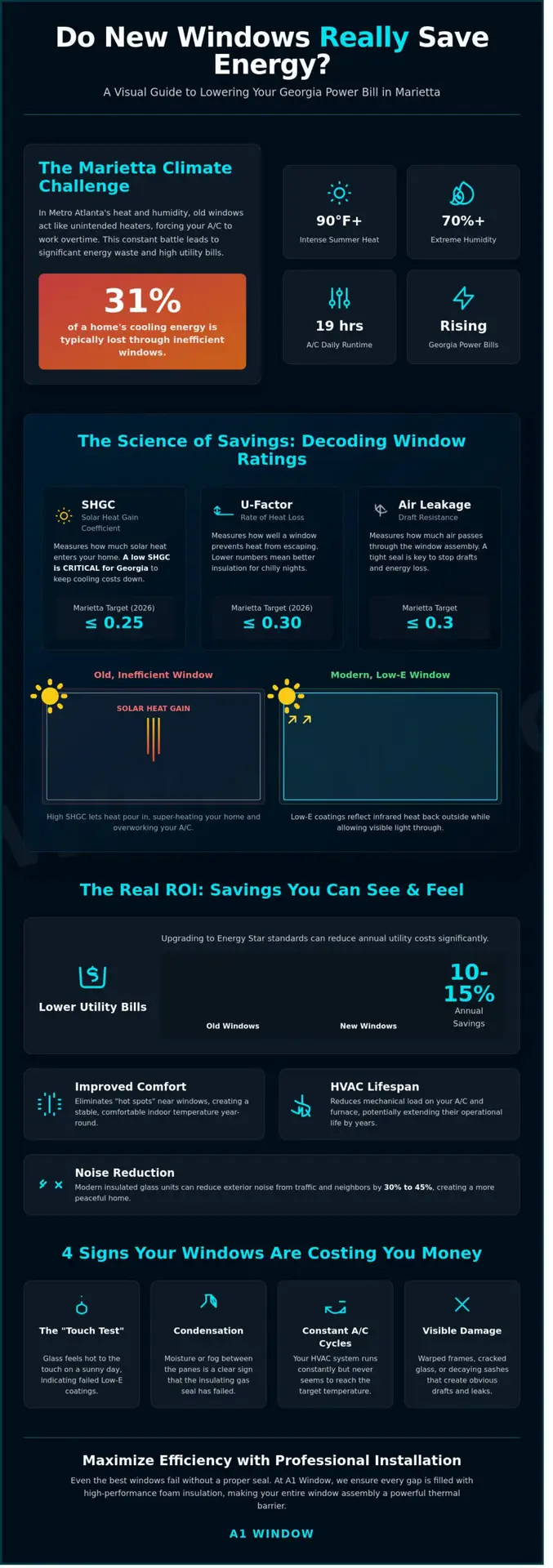
Marietta homeowners often ask if upgrading their glass is a practical investment. To answer the question, do new windows save energy, you have to look at how they function as a barrier against Georgia’s intense humidity. Old, single-pane windows act like unintended heaters during July peaks. This happens through “Solar Heat Gain,” where the sun’s rays pass through the glass and trap heat inside your living room. Modern units stop this transfer. By upgrading to 2026 Energy Star standards for the Southern climate zone, you can expect to reduce your annual utility costs by 10% to 15% in North Georgia homes.
The science relies on how insulated windows work to create a thermal break between your home and the outdoors. In Marietta, where summer temperatures regularly exceed 90 degrees, these barriers keep the cool air you pay for from escaping through the glass. A1 Window Services focuses on ensuring your window sash and frames are sealed tight to prevent air leakage that compromises your HVAC efficiency. High-performance coatings now reflect infrared light, which keeps the interior glass surface cooler to the touch even in direct sunlight.
The Georgia Power Factor: Why Cooling Costs Dominate
In Metro Atlanta, cooling your home is far more expensive than heating it. Old windows force your AC unit to run longer cycles to combat the 70% humidity levels common in our region. When a window frame fails, it creates a thermal bridge, which is a specific point in the window assembly that allows heat to bypass insulation and flow directly into your home. This constant heat transfer means your system never gets a break. Replacing or repairing these units reduces the mechanical load, lowering your monthly Georgia Power statement immediately. It’s a direct way to stop paying for energy that literally flies out the window.
Beyond the Bill: The Comfort ROI
Energy savings aren’t just about the numbers on a bill. New glass eliminates the “hot spots” often felt near large picture windows during afternoon sun exposure. This stabilization of indoor temperatures means your HVAC system doesn’t have to work overtime, which can extend its operational lifespan by several years. Additionally, homeowners in busy Cobb County neighborhoods see a 30% to 45% reduction in exterior noise. Whether it’s traffic on Whitlock Avenue or a neighbor’s lawnmower, the same technology that keeps heat out also keeps your home quiet. You gain a more peaceful environment while the hardware does the heavy lifting of climate control.
The Science of Savings: U-Factor and SHGC Explained
Understanding how windows function requires looking past the glass and into the technical ratings. Many homeowners ask, do new windows save energy? The answer lies in the data. Because heat transfer occurs through the glass and frame, windows often account for 25%–30% of residential heating and cooling energy use. To minimize this loss, you must focus on two primary metrics: U-Factor and SHGC.
The U-Factor measures the rate of heat loss. It tells you how well the window prevents heat from escaping your home during a chilly January night in Marietta. Lower numbers represent better insulation. For our 2026 climate standards, a U-Factor of 0.30 or lower is the target for high-performance glass. For a complete breakdown of window U-factor for Georgia homes, including specific recommendations for Marietta’s climate zone, understanding these ratings is crucial for maximizing your energy savings.
While U-Factor handles the cold, the Solar Heat Gain Coefficient (SHGC) manages the Georgia sun. This rating measures how much solar radiation enters your home. In the South, a low SHGC is vital to keep your air conditioner from cycling constantly. Finally, check the Air Leakage rating. Even the best glass fails if the seal allows drafts. Look for a rating of 0.3 cfm/sqft or less to ensure a tight fit.
Why SHGC is the Priority for Atlanta Area Homes
The Georgia sun provides intense infrared heat that can quickly turn a living room into a greenhouse. A lower SHGC is better for windows with heavy sun exposure. Modern windows use Low-E coatings, which are microscopic layers of silver or tin oxide. These coatings reflect heat back to its source while allowing visible light to pass through.
For Marietta homes in 2026, we recommend an SHGC of 0.25 or lower. This rating ensures that your cooling system doesn’t have to fight the afternoon sun. If your current windows feel hot to the touch during the day, you might request a professional inspection to see if your coatings have failed.
Double-Pane vs. Triple-Pane: What’s Best for North Georgia?
Choosing between glass packages often comes down to a cost-benefit analysis. Double-pane windows are the industry standard, featuring two sheets of glass with a spacer. Triple-pane windows add a third layer, increasing the R-value from approximately 3 to 5.
- Double-Pane: Provides excellent value for Marietta’s mild winters and is significantly lighter on window sashes.
- Triple-Pane: Offers superior sound dampening and maximum insulation, though the extra cost takes longer to recoup in energy savings.
- Argon Gas: Most high-quality units use Argon gas between the panes. It is 6 times denser than air, which significantly slows down thermal transfer.
In our local climate, a well-built double-pane window with a 90% Argon fill is usually the most practical choice for maximizing your return on investment.
Calculating the Real ROI: Do Windows Pay for Themselves?
Many Marietta homeowners hesitate at the initial price tag of a full window replacement. It’s a significant investment, but looking at the “payback period” solely through energy bills is a mistake. To get an honest ROI, you have to look at the total cost of ownership. In 2026, the federal government continues to support these upgrades through the Energy Efficient Home Improvement Credit. This tax credit allows you to claim 30% of the cost of ENERGY STAR certified windows, up to a maximum of $600 per year. When you combine this with the 68% average cost recovery in home resale value, the financial math starts to shift in your favor immediately.
The question of do new windows save energy depends on more than just the glass itself. It’s about stopping the “money leak” that occurs in older Georgia homes. Modern vinyl or composite frames eliminate the need for the constant scraping, priming, and painting required by older wood windows. If you’re spending $200 per window every four years for professional maintenance, that’s a recurring expense that disappears the day your new units are installed. You’re trading a high-maintenance liability for a low-maintenance asset.
The Hidden Cost of Waiting to Replace
Delaying your replacement often leads to “stealth costs” that don’t show up on a utility bill. Rotting wood sashes can lead to structural damage in your wall framing, turning a simple window job into a $10,000 siding and framing repair. Additionally, old single-pane glass allows 75% of UV rays to enter your home. This radiation destroys the finish on hardwood floors and fades expensive furniture. By replacing windows now, you protect the interior investments you’ve already made. With local energy prices rising by an average of 4% annually, every year you wait makes your current windows more expensive to keep.
Windows as a Component of Whole-Home Efficiency
Think of your home as a thermal envelope. If you have a well-insulated attic but 20-year-old windows, your HVAC system is still fighting a losing battle. The U.S. Department of Energy explains window energy ratings like U-factor and Solar Heat Gain Coefficient (SHGC) as the primary metrics for performance. In Marietta’s humid climate, a low SHGC is vital to keep the summer heat out. While windows are often the weakest link in a home, they work best when paired with proper weatherstripping and insulation. If you’re ready to look at specific options, check out our guide on Choosing the Best Replacement Windows for Marietta Homes. So, do new windows save energy effectively? They do, provided they are selected to match the specific solar orientation of your house.
Signs Your Old Windows are Costing You Money Every Month
Identifying window failure is the first step in answering the question: do new windows save energy? If your HVAC system runs constantly without reaching the thermostat setting, your windows are likely the culprit. You can spot these leaks through a few simple physical tests that don’t require any special tools.
- The Touch Test: During a typical 90-degree Marietta July afternoon, touch the interior glass of your windows. If the surface feels hot, your thermal barrier has failed. This heat transfer forces a standard 15-SEER air conditioner to work 20% harder to maintain a comfortable indoor temperature.
- Fogged Panes: Condensation or “fog” trapped between the glass layers indicates a dead thermal seal. Once the insulating argon gas escapes, the window’s R-value drops significantly, leaving you with nothing more than two thin sheets of glass for protection.
- Difficult Operation: If a sash is hard to lift, sticks, or won’t stay open, the frame has likely warped. Even a 1/16th-inch gap around a warped frame allows as much air leakage as a 3-inch hole in your wall.
The Marietta Humidity Check: Rot and Mold
Georgia’s average morning humidity of 70% often leads to wood rot in older homes. Inspect your sills and sashes for soft spots or peeling paint; these are clear indicators that moisture is compromising the unit’s structural integrity. To find invisible drafts, try the candle test. Hold a lit candle near the window frame on a breezy day, and if the flame flickers or blows out, you’re losing expensive, conditioned air through the frame.
A1 Window’s ‘Repair vs. Replace’ Rule of Thumb
We believe in honest assessments. If your frames are solid and the only issue is a dry exterior seal, a simple re-caulking can often extend the window’s life. However, if the wood is soft or the thermal seal is broken, a full unit replacement is the only way to guarantee results. While glass-only fixes are available, they don’t address the air infiltration through an aging, leaky frame. Replacing the entire unit is the most reliable way to ensure your investment actually lowers your utility bills, proving that do new windows save energy isn’t just a marketing claim but a technical reality. You can learn more about these choices in our guide on Window Repair vs. Replacement in Marietta. For a comprehensive evaluation of your home’s current condition, our detailed guide on 7 warning signs you need new windows in Marietta provides a complete checklist to help you determine if replacement is necessary.
Maximizing Efficiency with Professional Marietta Installation
Buying high-performance glass is only half the battle. Even the most advanced units fail to deliver results if the installation is subpar. If a frame isn’t perfectly level or sealed, air leaks around the edges, rendering your investment useless. This is why the answer to do new windows save energy depends largely on the quality of the craftsmanship behind the glass.
A1 Window focuses on the technical details that prevent thermal bridging. We use specific methods to ensure a permanent seal:
- Proper Flashing: We install weather-resistant barriers to direct moisture away from the wall cavity, preventing rot in Georgia’s humid climate.
- Low-Expansion Foam: Unlike standard fiberglass insulation, this foam expands to fill every microscopic void between the window frame and your home’s rough opening.
Our approach is built on the helpful neighbor philosophy. We don’t use high-pressure sales tactics. Instead, we provide a clear, technical assessment of your home’s current state and offer a solution that fits your specific budget and performance goals.
The A1 Standard for Marietta Homeowners
We specialize in full-frame replacements because they offer the best long-term energy performance. While inserts are cheaper, they often hide existing structural issues. Our team has spent over 15 years navigating the unique requirements of Marietta architecture, from historic homes near the Square to modern developments. We handle specialty shapes and custom sashes with precision, ensuring an airtight fit that accounts for the 70-degree temperature swings common in North Georgia.
Start Saving on Your Georgia Power Bill Today
The path from drafty, rattling panes to a quiet, efficient home is shorter than you think. By upgrading to modern standards, the average Georgia homeowner can reduce their annual energy costs by 12% according to 2024 Energy Star data. We’ll help you find the right balance between initial cost and long-term savings. Stop letting your expensive cooled air leak into the yard this summer.
Maximize Your Marietta Home Savings Starting Today
Upgrading your property is about more than just curb appeal; it’s about taking control of your monthly utility costs. If you’re wondering do new windows save energy, the answer lies in the data. Modern units with a low U-Factor can reduce thermal transfer by up to 30% during a typical Georgia summer. Since 1993, A1 Window Services has provided Marietta homeowners with reliable solutions tailored to our local climate. We focus on full-unit replacements because this method ensures the highest return on investment by sealing the entire opening against the elements.
Old, leaky frames often force your HVAC system to work 20% harder than necessary. By switching to energy-efficient glass, you stop paying for conditioned air that simply drifts outside. Our team brings over 30 years of experience to every job, ensuring your installation meets the strict 2026 standards for efficiency and durability. We don’t use high-pressure tactics. We provide the technical clarity you need to make an informed decision for your family. You’ll appreciate our grounded, professional approach that restores your home’s comfort and long-term value.
Get a Free Quote on Energy Efficient Windows in Marietta to see how much you’ll save this year. We look forward to helping you achieve a more comfortable, efficient home.
Frequently Asked Questions
How much can I really save on my energy bill with new windows?
Marietta homeowners typically save between 12% and 15% on their annual utility bills after upgrading to Energy Star certified models. If your current monthly bill averages $200, you could keep an extra $360 in your pocket every year. These savings come from reducing the workload on your HVAC system during 90 degree Georgia summers. We focus on providing the A1 standard of efficiency to ensure your investment pays off quickly.
Is it worth replacing double-pane windows that are 20 years old?
You should consider replacement if your windows are two decades old, as the seals on thermal panes usually fail after 15 to 20 years. Once the seal breaks, the insulating gas escapes and moisture gets in, leading to foggy glass. This failure reduces your window’s insulating power by roughly 30%. Replacing these aged units prevents drafts and protects your home from the humid Marietta air.
What is the best window material for energy efficiency in Georgia?
Vinyl and fiberglass are the top performers for the Georgia climate because they don’t warp or rot in high humidity. Multi-chambered vinyl frames provide a thermal break that reduces heat transfer by 40% compared to old metal frames. These materials require very little maintenance and maintain a tight seal for 25 years or more. We recommend these options to provide the best long term value for local families.
Can I just replace the glass to save energy instead of the whole window?
You can often restore energy efficiency by replacing only the glass unit if your existing frames are in good condition. This process, known as thermal pane replacement, costs about 50% less than a full window installation. It effectively eliminates foggy glass and restores the original R-value of the window. Our team prioritizes this practical solution whenever possible to save you money while fixing the immediate problem.
Do new windows help with my home’s resale value in Marietta?
New windows provide an average return on investment of 70% when you sell your home. Data shows that 85% of buyers in the Marietta area prioritize energy-efficient features to avoid immediate repair costs after closing. High quality windows improve curb appeal and signal that the property has been well maintained. It’s a reliable way to increase your asking price while making the home more attractive to potential buyers.
How long does it take for energy-efficient windows to pay for themselves?
Most homeowners see a full return on their investment within 10 to 15 years through lower utility bills and increased home value. When people ask, “do new windows save energy,” they often forget about the reduced wear on their air conditioner. A more stable indoor temperature means your HVAC system lasts 3 to 5 years longer. This hidden saving adds up significantly over the life of the windows.
Are there tax credits available for window replacement in 2026?
The federal government offers a tax credit of 30% for energy-efficient improvements, capped at $600 per year for windows. This incentive is part of the Energy Efficient Home Improvement Credit which is scheduled to remain available through 2032. You must choose products that meet Energy Star Most Efficient criteria to qualify. We can help you identify which models meet these strict 2026 standards for your Marietta home.
What is the difference between U-Factor and SHGC for Southern homes?
U-Factor measures how well a window prevents heat from escaping, while SHGC measures how much solar heat it lets in. In Georgia, the Solar Heat Gain Coefficient (SHGC) is more important for cooling. You should look for an SHGC rating of 0.25 or lower to block 75% of the sun’s heat. This keeps your home cooler during July and August without forcing your AC to run constantly.