
What if the small numbers on your window sticker were more important for your bank account than the brand name on the frame? If you live in an older Marietta neighborhood like Whitlock or Kennesaw Ave, you’ve likely noticed that a 90-degree July afternoon feels much hotter inside than it should. Many homeowners assume their HVAC is failing, but the real culprit is often an incorrect window u-factor georgia residents need to block heat transfer. We agree that technical jargon shouldn’t stand between you and a comfortable, energy-efficient home.
This guide will teach you exactly what U-factor ratings mean for your Marietta property and how to choose the best glass for our humid climate. We’ll explain the difference between U-factor and SHGC, identify the specific ratings that save you money, and show you how to restore your home’s efficiency without always resorting to a full replacement. By the end, you’ll have the clarity needed to stop drafts and lower your cooling costs by up to 12 percent according to Energy Star 2023 performance reports.
Key Takeaways
- Understand why U-factor is the essential measurement for keeping your Marietta home comfortable during both humid July afternoons and chilly January nights.
- Identify the specific window u-factor georgia homeowners should aim for in 2026 to qualify for maximum energy rebates and peak efficiency.
- Learn how to balance U-factor with Solar Heat Gain Coefficient (SHGC) to ensure your new windows provide a complete thermal barrier against the elements.
- Discover the simple math behind U-factor and R-value to avoid common misconceptions when comparing different thermal pane options.
- Find out why professional installation is the only way to ensure your window’s energy ratings actually translate into lower monthly power bills.
Understanding Window U-Factor in the Georgia Climate
U-factor measures the rate of non-solar heat loss or gain through a window assembly. While many homeowners focus on how much sunlight enters a room, the U-factor tracks the heat that creeps through the glass, frames, and spacers. In Marietta, this rating is a vital tool for managing your home’s internal temperature. During a 95-degree afternoon in July, a window with a poor rating allows outdoor heat to seep inside, forcing your air conditioner to work overtime. Conversely, in the middle of a January cold snap, that same window lets your expensive furnace heat leak out into the yard.
A lower U-factor indicates better insulation. This performance directly impacts your monthly utility bills and the lifespan of your mechanical systems. When you install windows with an optimized window u-factor georgia homeowners can expect their HVAC units to cycle less frequently. Reducing the workload on your AC doesn’t just save money on electricity; it also prevents premature wear on your compressor and blower motor. For a typical Cobb County home, upgrading from single-pane glass to high-efficiency units can reduce energy loss by 30% or more.
The Science of Heat Transfer in Metro Atlanta
Heat moves through your home via conduction, convection, and radiation. Conduction happens when heat travels through solid materials like the window frame. Convection occurs when air moves across the glass surface, and radiation involves heat moving through space. In Metro Atlanta, high humidity levels make these processes more aggressive. Moist air holds more energy than dry air, which places a higher demand on your home’s thermal envelope. Scientists quantify this movement through thermal transmittance, which measures the heat flow through the entire window unit rather than just the glass.
U-factor is the measure of how well a window prevents heat from escaping or entering your living space.
Why One Rating Does Not Fit All Climates
Georgia homeowners face different challenges than those in the North. In states like Maine or Minnesota, windows are designed primarily for heat retention to combat sub-zero temperatures. In Marietta, we require a balanced window u-factor georgia rating that handles both extreme humidity and occasional freezes. A window that is too focused on heat retention might trap unwanted warmth during our long summers, leading to a “greenhouse effect” inside your living room.
Local weather patterns also impact the physical integrity of your windows. Georgia’s rapid temperature swings, where a 40-degree morning turns into an 80-degree afternoon, cause materials to expand and contract quickly. High-quality windows with the correct U-factor are built to withstand this stress. This prevents the premature failure of the thermal seal, which often leads to the “foggy glass” look common in older Marietta neighborhoods. Choosing a balanced rating ensures your windows remain clear and efficient for their full 20-year lifespan.
U-Factor vs. SHGC: Which Rating Matters More for Marietta Homes?
Choosing the right windows for a Marietta home involves more than picking a frame color. You have to understand how the glass handles energy. U-factor and Solar Heat Gain Coefficient (SHGC) are the two most important numbers on any window sticker. U-factor measures how well the window prevents heat from escaping your home. SHGC measures how much heat from the sun enters through the glass. In our climate, these two ratings must work in tandem to keep your energy bills predictable.
A low window u-factor georgia homeowners should look for is around 0.30 or less. This provides the thermal foundation your home needs during chilly January nights. However, SHGC is often the “star” of the show during our long, humid summers. If your SHGC is too high, your air conditioner will struggle to keep up with the radiant heat pouring through your West-facing windows. Balancing these two ratings ensures your home stays comfortable regardless of the season.
Decoding the NFRC Label
When you visit a showroom, look for the National Fenestration Rating Council (NFRC) label. It’s the only way to verify true performance. This label provides a clear breakdown of energy performance ratings that are tested and certified by third parties. Beyond U-factor and SHGC, pay attention to Visible Transmittance (VT). VT is expressed as a number between 0 and 1. A higher VT means more natural light enters the room. Most Marietta residents prefer a VT above 0.50 to maintain a bright, airy feel without sacrificing thermal protection.
The Role of SHGC in the South
In Georgia, the sun is your biggest opponent. A high SHGC creates a “greenhouse effect” in sun-drenched rooms like sunrooms or kitchens. This leads to faded furniture and skyrocketing cooling costs. Some common signs you need new windows include feeling a “wall of heat” when you walk past a window or noticing that your AC never stops running in August. While the window u-factor georgia requires provides the necessary insulation, a low SHGC (ideally below 0.23) is what actually stops the sun from baking your interior.
Low-E coatings are the technology that makes this balance possible. These microscopic layers of silver or tin oxide reflect heat back to its source. In the winter, they reflect indoor heat back into your living space. In the summer, they reflect solar radiation back outside. Modern spectrally selective coatings allow you to achieve a low SHGC without making your windows look dark or tinted. This technology helps restore the clarity and efficiency of your home’s envelope. If you aren’t sure if your current glass is performing correctly, you can request a professional inspection to check for seal failure or coating degradation.
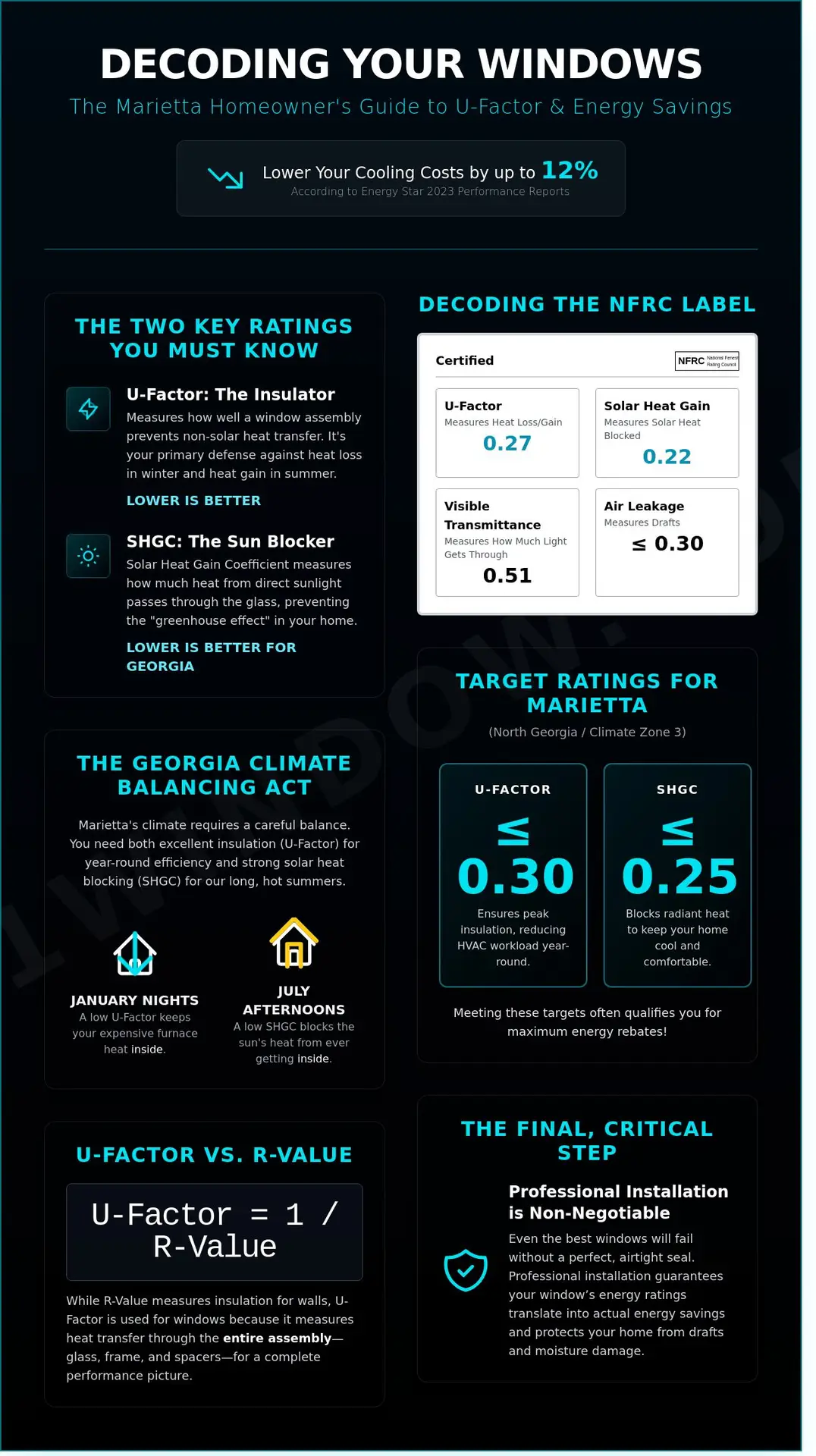
The Inverse Relationship: Why Windows Use U-Factor instead of R-Value
Most homeowners in Marietta are familiar with R-value. You see it printed on rolls of pink fiberglass insulation at the local hardware store. For attic floors and crawlspaces, a higher R-value means better thermal resistance. Windows operate on a different scale. Engineers use U-factor because windows are complex assemblies, not solid blocks of material. This measurement tracks the rate at which heat flows through the entire unit, including the glass, frame, and spacers. When shopping for a window u-factor georgia homeowners should remember that a lower number indicates a more efficient product. The math is simple: U-factor is the mathematical inverse of R-value, expressed as U = 1/R.
Why Glass is Different from Insulation
Measuring heat flow through transparent glass is more difficult than measuring solid wood or foam. Windows deal with conduction, convection, and radiation simultaneously. Modern thermal panes use air gaps or dense gases like Argon and Krypton to slow this movement. These gases are much denser than oxygen, providing a buffer that resists heat transfer. While a higher R-value is better for walls, a lower U-factor is the goal for energy-efficient windows. You can find detailed energy performance ratings for windows through the Department of Energy to see how these factors impact your home’s utility costs. These ratings help you identify which products actually keep the heat out during a humid Georgia July.
Converting U-Factor to R-Value for Easy Comparison
It helps to see these numbers side-by-side to understand why windows are the “weak link” in a home’s thermal envelope. A standard insulated wall in a Cobb County home often has an R-value of R-13 or R-19. Even a high-performance double-pane window with a U-factor of 0.30 only translates to an R-value of 3.33. This gap explains why you feel the heat radiating off a window even if your walls feel cool to the touch. Use this quick cheat sheet for your next home project:
- U-Factor 0.50: Equivalent to R-2.0 (Common in older double-pane units).
- U-Factor 0.30: Equivalent to R-3.33 (Current Energy Star standard for many regions).
- U-Factor 0.25: Equivalent to R-4.0 (High-efficiency glass with specialized coatings).
Modern double-pane technology has revolutionized these numbers for local homes. Before the 1980s, single-pane glass offered an R-value of roughly 1.0. Today, high-quality units reduce the strain on your HVAC system by up to 12 percent compared to older models. Understanding your window u-factor georgia requirements ensures you choose glass that handles our 90-degree afternoons without forcing your air conditioner into overdrive.
Selecting the Right Energy Ratings for North Georgia Climate Zones
For Marietta homeowners, choosing the right window u-factor georgia means balancing local weather patterns with long-term financial goals. By 2026, we recommend aiming for a U-factor of 0.30 or lower for any replacement project. While this meets standard efficiency needs, 0.27 is the current “Gold Standard” for those seeking the highest available Georgia Power rebates. Reaching these numbers involves looking at the entire window assembly, not just the glass thickness.
- Double vs. Triple Panes: Double-pane windows with argon gas fills are the standard for our region. However, triple-pane units provide a significant improvement in thermal resistance, which is ideal for noise reduction and blocking extreme summer heat.
- Frame Materials: Vinyl frames are a top choice in Marietta because they don’t conduct heat like aluminum. Wood frames offer great natural insulation but usually come with more upkeep requirements. We find that multi-chambered vinyl frames provide the best balance of cost and thermal performance for local homes.
Energy Star 2026 Standards for the Southern Zone
The Energy Star Version 7.0 requirements for 2026 set a high bar for the Southern Zone. These standards ensure windows block enough solar heat to keep cooling costs manageable. Simply meeting the minimum building code often leaves money on the table. Investing in higher-rated units shows how do new windows save energy by preventing your AC from cycling constantly during a Georgia heatwave. These standards act as a blueprint for a more efficient, comfortable home.
Customizing Ratings for Your Home’s Orientation
A smart window strategy treats the front of your house differently than the back. West-facing windows in Marietta take a beating from the afternoon sun. These require a lower Solar Heat Gain Coefficient (SHGC) to stop the “greenhouse effect” in your living room. North-facing windows don’t receive as much direct sun, so you can focus more on the U-factor to keep heat inside during the winter months.
A1 Window Services specializes in mixing and matching these ratings for our customers. This custom approach ensures you aren’t overpaying for glass where you don’t need it while maximizing performance where it matters most. Choosing the right ratings for each side of your home can shave 12% to 15% off your monthly utility bills depending on the age of your current windows. It’s about practical solutions that fit your specific floor plan.
Beyond the Label: Why Professional Installation Protects Your U-Factor
You can buy the most efficient window on the market, but the sticker price and the lab-tested window u-factor georgia rating only tell half the story. If the installation is flawed, that high-performance glass won’t save you a dime. A window is a system, not just a pane of glass. When the seal between your home’s wall and the window frame fails, heat moves freely. This creates thermal bridges that bypass your investment entirely. At A1 Window, we focus on a “thermal bridge-free” installation process. We ensure the transition from your Marietta home’s siding to the window frame is airtight and moisture-proof. The best rating in the world is useless if the wind blows right around the sash.
The Hidden Threat of Air Leakage
Air leakage is the silent killer of energy efficiency. Gaps in the rough opening allow Marietta’s humid summer air to seep inside, forcing your HVAC system to work harder. DIY projects often skip critical steps like professional-grade flashing or specialized low-expansion foam insulation. Without these, you risk water intrusion and drafts. Industry data suggests that improper installation can degrade a window’s effective thermal performance by as much as 40 percent. We don’t let that happen. Our team seals every perimeter to ensure the window performs exactly as the manufacturer promised. We use high-quality sealants that remain flexible over time, preventing the cracks that lead to energy loss as your home settles.
Your Local Marietta Partner for Energy Efficiency
We believe in doing the job right the first time. Our Marietta technicians focus on the A1 standard. This means we combine high-performance products with expert craftsmanship that eliminates air pockets and thermal leaks. We don’t just swap out glass; we restore your home’s envelope. If you aren’t sure how your current setup measures up, we can provide a professional assessment of your window u-factor georgia needs. It’s better to know the truth about your thermal loss now than to pay for it on your next utility bill.
Explore our full range of replacement windows designed for Georgia to see how we prioritize both quality and local expertise. We’re here to help you make an informed, honest choice for your home’s future. Our process includes:
- Precision measurements of every rough opening to minimize gaps.
- Application of professional-grade flashing to prevent moisture rot.
- Use of thermal-efficient insulation between the window frame and your home.
- A final inspection to ensure the sash operates smoothly and seals tightly.
Trusting a local expert means you get a window that stays efficient for decades, not just a few seasons. We take pride in protecting your Marietta home from the Georgia heat with clarity and integrity.
Secure Your Home’s Efficiency for the Years Ahead
Choosing the right window ratings isn’t just about reading a label. It’s about matching modern technology to our specific North Georgia climate. You now understand that a lower U-Factor keeps heat inside during winter while the right SHGC prevents the Marietta sun from overheating your home. Since Energy Star Version 7.0 updated its criteria, finding the ideal window u-factor georgia homeowners need requires balancing local weather patterns with high-performance glass. Even the best thermal pane fails if the installation isn’t precise.
A1 Window Services has served the Marietta community since 1993. We provide expert installation of Energy Star rated windows that meet our A+ standard for thermal performance and clarity. We focus on practical solutions that improve your home’s efficiency and comfort. Our team helps you navigate these technical ratings to find the best fit for your property’s specific needs. Get a Free Estimate on Energy-Efficient Windows for Your Marietta Home and start saving on your monthly utility bills today. We look forward to helping you upgrade your home with honest, reliable service.
Frequently Asked Questions
What is a good U-factor for windows in Georgia?
A good window u-factor georgia homeowners should aim for is 0.32 or lower. This rating meets the ENERGY STAR Version 7.0 specifications for the Southern-Central climate zone. While older windows often have ratings above 0.50, modern high-performance units frequently reach 0.27. Choosing a lower number ensures your Marietta home stays warmer during January nights when temperatures regularly drop below 30 degrees.
Does a lower U-factor really save money on my Georgia Power bill?
Yes, a lower U-factor directly reduces your monthly Georgia Power statement. According to the U.S. Department of Energy, installing ENERGY STAR certified windows saves homeowners an average of 12 percent on annual utility costs. Since the U-factor measures how well a window prevents heat from escaping, a low rating keeps your furnace from running constantly during winter. This efficiency translates into tangible savings every month.
Is U-factor or SHGC more important for homes in Marietta?
Both metrics matter, but Solar Heat Gain Coefficient (SHGC) is often more critical for Marietta homes due to our 217 sunny days per year. While the window u-factor georgia rating prevents heat loss in winter, SHGC controls how much heat from the sun enters your home in July. In Georgia, the ENERGY STAR requirement for SHGC is 0.23 or lower. Balancing a low SHGC with a solid U-factor provides year-round comfort.
Can I improve the U-factor of my existing windows without replacing them?
You can improve efficiency without a full replacement by repairing failed thermal panes or adding low-E glass coatings. Replacing old, cracked weatherstripping can reduce air infiltration by up to 20 percent. If your glass is foggy, the insulating gas has likely escaped. A1 Window Services specializes in moisture removal and seal restoration. These services restore the window’s original insulating properties without the high cost of new frames.
What is the difference between U-value and U-factor?
U-value measures the heat transfer through a specific material like a single pane of glass. U-factor refers to the performance of the entire window assembly, including the frame, spacer, and glass. The National Fenestration Rating Council (NFRC) uses U-factor for its official labels because it provides a more accurate picture of how the whole unit performs in your home. Always look for the NFRC label to ensure accuracy.
How does gas fill like Argon affect the U-factor of a window?
Argon gas improves a window’s U-factor by roughly 16 percent compared to standard air-filled units. Because Argon is denser than oxygen, it slows down the movement of heat between the glass panes. This denser barrier minimizes convection currents inside the thermal pane. Most Marietta homeowners choose Argon because it’s a cost-effective way to reach the 0.30 U-factor threshold required for modern energy efficiency standards.
Do triple-pane windows have a significantly better U-factor for Georgia climates?
Triple-pane windows offer a U-factor as low as 0.15, which is roughly 40 percent better than standard double-pane units. However, this level of insulation is often unnecessary for Georgia’s milder winters. A high-quality double-pane window with a Low-E coating and Argon gas usually provides the best return on investment for our climate. You get the thermal protection you need without the added weight and expense of a third glass layer.
Why don’t window manufacturers use R-value on their labels?
Window manufacturers use U-factor because it measures the rate of heat flow, whereas R-value measures heat resistance. While R-value is standard for wall insulation, it doesn’t account for the complex way heat moves through glass and frames. You can calculate the approximate R-value by dividing 1 by the U-factor. For example, a window with a 0.31 U-factor has an R-value of approximately 3.2.